
Péloquin Project
2019
Built in 1950, this duplex was transformed into a single-family home to meet the growing needs of a small Montreal family.
The project unfolded over two years. The first phase involved converting the upper unit to create three bedrooms, a home office, and the family bathroom. In the second phase, the ground floor was opened up to allow the living spaces to connect with one another while also opening toward the backyard. Bringing natural light and greenery into the home was a key aspect of the transformation: a lively house, closely connected to its surroundings.

Project Information
Complete reconfiguration of the ground floor, including the addition of two concealed wood beams;
Replacement of plumbing and electrical systems;
Renovation of two bathrooms and the kitchen;
Insulation of exterior walls, full replacement of doors and windows, addition of a skylight and a heat pump;
Partial finishing of the basement;
Replacement of the balconies.
General Contractor
Mètre carré (Construction Archetype) and self-build
Construction Duration
2x 5 months
Construction Cost
300 000$
The Entry and Ground Floor: Flow and Sociability
From the moment you enter, circulation naturally leads toward the living spaces. The original load-bearing wall was partially opened to create sightlines through the house and allow light from the garden to reach the heart of the home. The living room, dining room, and kitchen now form a fluid and luminous ensemble, where each area maintains its own character while remaining in dialogue with the others. The goal was to create a place where everyone can move freely, gather together, or simply enjoy a quiet moment. The choice of materials—light wood, neutral tones, and natural textures—reinforces this sense of coherence and calm.
A Spacious and Welcoming Entry
As soon as you step inside, it becomes clear that the house was designed with family life in mind. The original staircase was reconfigured to open toward the heart of the home, making it possible to create a spacious and light-filled entry. A large built-in bench welcomes coats, school bags, and conversations before heading out the door—a simple detail that makes a big difference in the daily life of a family.


Open yet Well-Defined Living Spaces
The ground floor spaces—the kitchen, dining room, and living room—are open to one another, yet each retains its own character. The living room was intentionally kept slightly set apart. With three children, the kitchen and dining area are often lively, and it is pleasant to have a quieter space to retreat to, whether to read, talk, or simply unwind. This subtle separation creates two complementary atmospheres: one for activity and meals, the other for relaxation, while maintaining a visual connection and a fluid relationship between the spaces.
A Kitchen Designed for Gathering
The kitchen truly forms the heart of the home. Around the large central island, cooking, conversations, and shared moments naturally unfold. The generous work surfaces allow several people to prepare a meal at once without getting in each other’s way, while a wall pantry with sliding doors provides practical and well-organized storage. Above the island, a few hanging plants introduce a touch of greenery and echo the surrounding nature.
A Home Open to the Backyard
The large patio door extends the dining room onto the outdoor terrace, where a dining area has been arranged on a slightly lower level. This opening creates a beautiful continuity between indoors and outdoors, filling the house with natural light throughout the day. During the warmer months, family life naturally flows out into the garden, creating a simple and welcoming atmosphere.
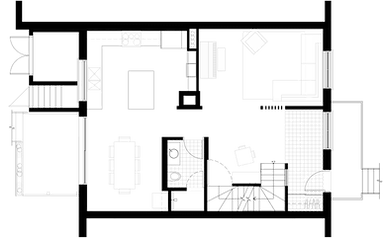
GROUND FLOOR PLAN

2nd FLOOR PLAN


The Upper Floor: Light and Functionality
Formerly a separate apartment, the upper floor was completely transformed to suit family life. The original living room was converted into a third bedroom, making it possible to create three bedrooms, a home office—easily convertible into an additional bedroom—and a large family bathroom. The bathroom itself was enlarged and redesigned to provide greater comfort and clarity. To prevent the central corridor from feeling dark, a roof opening was added, bringing natural light into the heart of the upper floor. Through this careful attention to light and circulation, the level remains bright, fluid, and welcoming, despite the presence of several enclosed rooms.
The Basement: Flexible and Practical
The basement was partially finished to accommodate the evolving needs of the family. At the front, a playroom for the children and an additional bedroom were created to host family and friends, or to serve as a future bedroom for the older children. The rear portion of the basement retains a more utilitarian character, with generous storage, a practical laundry room, a workshop, and a large mudroom providing direct access to the backyard. This space also serves as the family’s everyday entry—a practical place to leave coats and boots before heading upstairs to the living areas—an arrangement that makes the home as functional as it is enjoyable to live in.


Photo credit: Saul Rosales

La Flèche Project

Soubirous Project

St-Hubert Duplex

Bienville Project

Péloquin Project

Coloniale Project